
PayID Casino Real Money Pokies -- Funding Slots via Instant Bank Transfer
 Available in AU
Why Pokies Players Specifically Benefit From Instant Deposits
I once tracked my deposit-to-first-spin time across five different payment methods. Card: four minutes. E-wallet: two minutes with an existing balance, twenty minutes if funding the wallet first. Bank transfer: fourteen hours. PayID: forty-seven seconds. For pokies — a format built around session flow and rhythm — that difference in onboarding friction shapes the entire experience. Nobody wants to stare at a loading screen for fifteen minutes before their first spin.

Pokies represent the single largest revenue category in Australian online gambling. The broader online gambling market sits at USD 5.5 to 6.13 billion in 2025, and slots account for the dominant share of that figure. The mechanics of the format — short sessions, variable bet sizes, frequent small deposits — align precisely with what PayID does well: fast, low-friction, bank-to-operator transfers with no intermediary. The wider context is covered in our PayID casino guide.
How PayID Deposits Work for Pokies Sessions
The process is straightforward, but the details matter. You select PayID in the casino’s cashier, enter a deposit amount, and receive a reference number to include with your bank transfer. Open your banking app, send the payment using the casino’s PayID address (typically a phone number or email registered by the operator), include the reference, and confirm. The funds appear in your casino balance within seconds — ready to wager on any pokie in the lobby.

One thing that surprises new PayID users: the deposit does not lock you into pokies. A PayID deposit credits your general casino balance, which you can use across any game category — table games, live dealer, sports betting if the operator offers it. There is no earmarking unless a specific bonus requires it. This flexibility matters because many players start a session on pokies and shift to other games as the session evolves. PayID’s speed advantage applies at the deposit level, not the game level — once the money is in your account, the payment method is irrelevant to gameplay.
Matching Deposit Size to Pokies Bankroll Strategy
Here is where most guides get vague and unhelpful. Let me be concrete. If you are playing a standard online pokie at AUD 0.50 per spin, a AUD 50 deposit gives you 100 spins — roughly 15 to 20 minutes of play depending on your pace and whether you use auto-spin. A AUD 200 deposit extends that to 400 spins, which is a substantial session by any measure. The question is not “how much should I deposit” but “how long do I want this session to last, and what happens when it ends?”

PayID’s instant settlement makes top-up deposits dangerously convenient. There is no cooling-off period between deciding to deposit more and having those funds available. The twenty-minute bank transfer delay that frustrated you when you first tried to play actually served a useful function — it created a pause during which many players reconsidered whether they genuinely wanted to keep going. With PayID, that built-in friction disappears. The onus shifts entirely to the player to set limits before the session begins rather than relying on payment delays as an involuntary brake. The full treatment is in PayID pokies for real money.
The practical approach I use: deposit the full amount I have budgeted for the session at the start, and do not top up. If the balance runs out, the session is over. This turns PayID’s speed into a pure advantage — fast onboarding, no interruptions — without creating a frictionless path to overspending.
Pokies Volatility and Why Deposit Timing Matters
High-volatility pokies — the ones that pay infrequently but in larger amounts — require a different deposit strategy than low-volatility games that return small wins frequently. A AUD 50 deposit on a high-volatility slot might last 30 spins before dry patches consume the balance. The same amount on a low-volatility game can sustain 150+ spins because small returns continuously recycle into the balance.
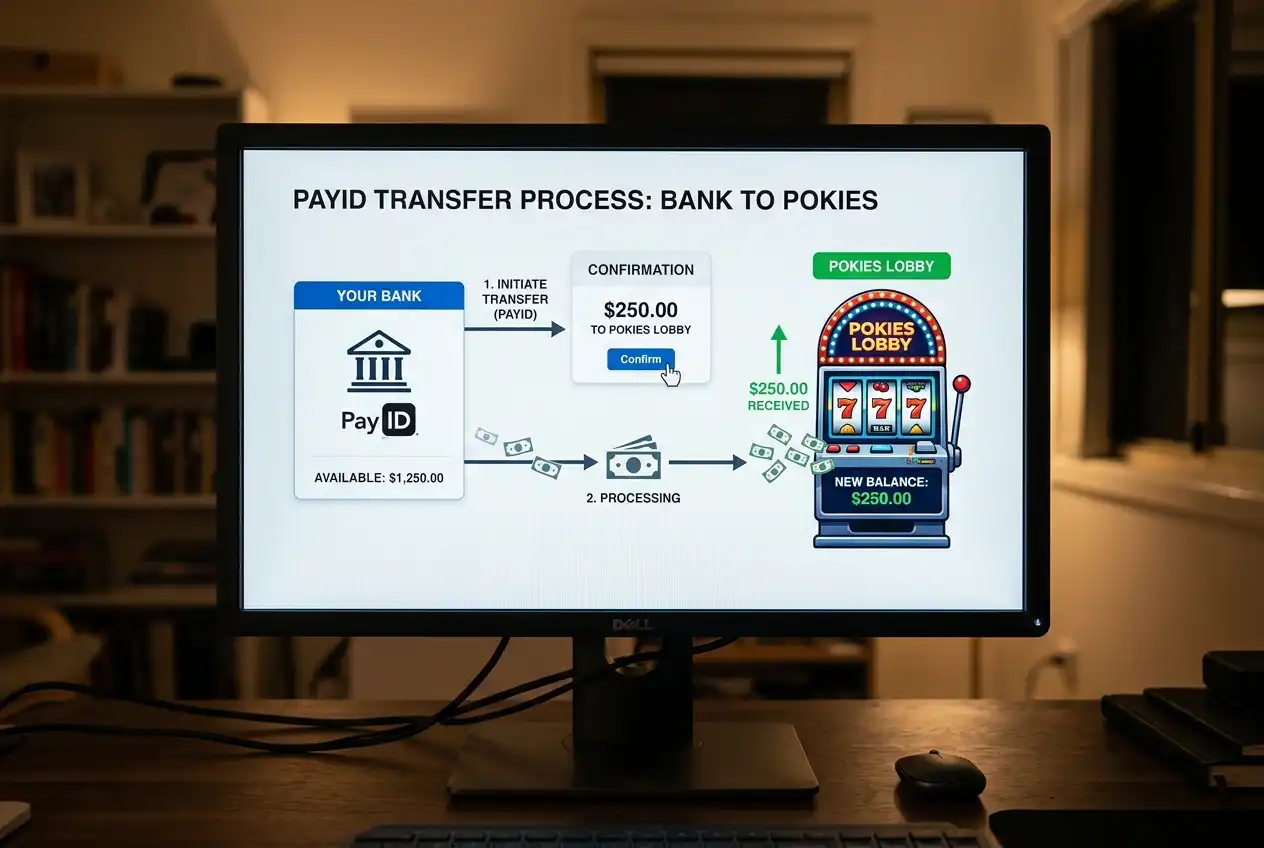
This has direct implications for how you use PayID. If your preferred games are high-volatility, a single larger deposit at the start of the session is more efficient than multiple small top-ups. Each top-up cycle — switching to the cashier, generating a reference, opening your banking app, confirming — takes 60 to 90 seconds. Multiply that across five or six top-ups in a session and you have spent nearly ten minutes on payment processing instead of playing.
Australians wagered AUD 244.3 billion in the 2022-23 financial year, and a significant portion of that volume flows through online pokies. The per-spin amounts are small, but the aggregate is enormous — a dynamic that PayID’s low transaction cost (roughly AUD 0.04 at the NPP wholesale level) accommodates well. The system does not care whether you deposit AUD 20 or AUD 2,000 — the cost and speed are functionally identical.
Withdrawing Pokies Winnings Back Through PayID
The withdrawal side receives less attention than deposits, but it is where the experience either completes the circle or falls apart. Most operators that accept PayID deposits also process withdrawals to the same PayID-linked account. The withdrawal processing time typically sits between two and twenty-four hours, depending on the operator’s manual review process — not the payment infrastructure itself. The NPP settles outgoing payments just as quickly as incoming ones; the delay is the casino’s internal verification and approval queue.

One pattern I see repeatedly: a player hits a substantial pokies win, requests a withdrawal, and then deposits again before the withdrawal processes. Some operators treat pending withdrawals as reversible — allowing you to cancel the withdrawal and return the funds to your playable balance. Others lock the withdrawal once submitted. Knowing which policy your operator follows before a big win avoids the moment of confusion that sometimes leads to impulsive decisions.
Session Management and the Psychology of Pokie Deposits
Something I have noticed over years of observing online pokies behaviour: the deposit pattern tells you more about a player’s relationship with the game than the bet size does. A player who deposits AUD 50 once and plays until it is gone has a fundamentally different risk profile than a player who deposits AUD 10 five times in the same session. The total spend is identical, but the second pattern involves four separate decisions to continue — each one a moment where the session could have ended but did not.

PayID makes both patterns equally frictionless, which is precisely why pre-session planning matters more with instant deposits than with slower methods. The Australian gambling market is the largest per-capita in the world, with total wagering reaching AUD 244.3 billion in a single financial year. The infrastructure enabling that spending is not the problem — the absence of deliberate spending limits is. Set the budget before you open the lobby, not after the first bonus round.
Written by the editors at PayEdge.