
PayID Casino Australia — The Data-Backed Guide to Casino Payments
 Available in AU
I spent the better part of nine years watching payment methods rise and collapse in the Australian online casino space. POLi had its moment. Credit cards dominated for a decade. Crypto showed up with big promises and bigger volatility. But nothing reshaped the deposit-and-withdraw cycle quite like PayID — a system that was never designed for gambling in the first place, yet became the fastest route between a player's bank account and a casino cashier.

The Australian online gambling market sits somewhere between USD 5.5 billion and USD 6.1 billion in 2025, depending on which research firm you ask. That is a staggering amount of money moving through payment rails every single day. And an increasingly large share of it now travels via the New Payments Platform — the infrastructure that makes PayID possible. The system was built by banks, endorsed by the Reserve Bank of Australia, and is now embedded in the daily financial life of the country.
This guide is not a list of operators with affiliate links dressed up as reviews. I wrote it as a technical breakdown of how PayID actually functions inside the casino payment ecosystem — what happens at the infrastructure level when you initiate a deposit, why withdrawals are not as "instant" as marketing departments claim, what the regulatory shifts of 2024 through 2026 mean for your money, and where the real security advantages lie compared to cards and crypto. Every statistic comes from a named source: NPP Australia, ACMA enforcement data, ABS fraud reports, government press releases.
The Numbers That Shape PayID Casino Payments Right Now
- Over 25 million PayIDs registered in Australia; the NPP processed nearly 2 billion real-time transactions in 2025, with wholesale costs dropping from $0.39 to $0.04 per transaction.
- PayID deposits settle in under 60 seconds. Withdrawals take 1–4 hours on verified accounts — the delay is casino-side processing, not the payment network.
- Card fraud cost AUD 854 million in FY25. PayID's push-payment model eliminates the credential-sharing that enables most card fraud.
- ACMA has blocked 1,708 illegal gambling sites. The June 2024 credit card ban and January 2027 advertising restrictions are reshaping the operator landscape.
- Zero fees on PayID deposits and withdrawals at most platforms — the NPP's infrastructure economics make free transactions viable.
PayID Round-Trip Auditor
Every PayID casino advertises the same half of the story: how fast money goes in. This tool measures the other half — how long the same money takes to come back out, and what stands between you and it. Fill in what the casino actually tells you, and read the receipt.
How to read this. A PayID transfer is a push payment over the New Payments Platform. It settles in seconds and it cannot be recalled by you — there is no chargeback, and the mistaken-payment process your bank runs is for money sent to the wrong account, not for money you meant to send. Under the Interactive Gambling Act 2001 it is an offence to offer real-money online casino games to people in Australia, so a casino accepting your PayID is operating from offshore and is not licensed here. That means no Australian regulator can order it to pay you. Every figure above is modelled from the terms you entered; check them against the casino's own cashier and terms pages before you deposit anything.
Gambling is a form of entertainment, not income. 18+. Free, confidential help in Australia: Gambling Help Online — 1800 858 858, gamblinghelponline.org.au.
How PayID Became Australia's Fastest Casino Payment Rail
In early 2018, a colleague at a payments consultancy told me that the New Payments Platform would "kill off slow banking in Australia within five years." I thought he was being dramatic. He was off by about a year — it took six — but the trajectory he described was dead accurate. PayID, the addressing layer built on top of the NPP, turned a clunky BSB-and-account-number system into something as simple as typing a phone number or email address. And the casino industry noticed immediately.
PayID — a unique identifier (mobile number, email address, or ABN) linked to your Australian bank account through the New Payments Platform. Instead of sharing your BSB and account number, you share your PayID, and the payment routes to your account in real time.
The adoption curve tells the story better than I can. By April 2025, more than 25 million PayIDs had been registered across Australia — a figure that essentially covers the entire adult population. The NPP processed close to 2 billion real-time transactions in 2025 alone, and one in every three account-to-account payments in the country now travels through this network. Lynn Kraus, the CEO of Australian Payments Plus, put it plainly: "Real-time payments have become part of everyday life in Australia, with one in three payments now processed via the NPP."

For online casinos, PayID solved three problems simultaneously. First, speed: deposits settle in seconds rather than the one-to-three-day window that traditional bank transfers require. Second, simplicity: players do not need to enter lengthy banking credentials on a casino site, which reduces both friction and error rates. Third, cost: the wholesale price of an NPP transaction has dropped from $0.39 in 2019 to roughly $0.04 by the 2024–25 financial year — a reduction that benefits operators and, in most cases, gets passed through to players as zero-fee deposits.
Why casinos adopted PayID so quickly — Online casinos operate on thin margins between deposit volume and player lifetime value. A payment method that settles instantly, costs almost nothing to process, and requires no third-party gateway is operationally ideal. PayID ticked every box, which is why it moved from "alternative method" to "primary method" at most Australian-facing platforms within two years.
The timing also mattered. When Australia banned credit card deposits for online gambling in June 2024, a significant chunk of transaction volume needed a new home. Debit cards absorbed some of it. Crypto took a slice. But PayID — already familiar, already instant, already free — captured the largest share of displaced deposits. It was not a marketing push that made PayID the dominant casino payment method in Australia. It was infrastructure readiness meeting a regulatory vacuum at exactly the right moment.
What separates PayID from the methods it replaced is the underlying architecture — a real-time gross settlement layer operated by major financial institutions, supervised by the Reserve Bank of Australia, and built to handle national-scale transaction volumes. Understanding that architecture matters, because it explains both the strengths and the limitations casino players encounter daily.
NPP, Osko, and PayTo — the Architecture Behind "Instant"
Most casino review sites use the word "instant" without ever explaining what makes it instant. The machinery deserves a closer look, because it directly affects how quickly your money moves — and why it sometimes does not move as quickly as you were told.
NPP (New Payments Platform) — the core real-time clearing and settlement infrastructure operated by Australian Payments Plus. It runs 24/7/365 and processes over 155 million transactions per month. Think of it as the highway; PayID and Osko are the vehicles that travel on it.
The NPP handles the heavy lifting. In 2024, the platform processed approximately 1.6 billion transactions worth around AUD 1.99 trillion. By the end of that year, more than 114 million accounts were connected to the network for sending and receiving. The scale is important because it means the system is not experimental — it is core national infrastructure, stress-tested at volumes that dwarf anything the casino industry generates.
Osko — the consumer-facing overlay service on the NPP that enables real-time fund transfers between bank accounts. When you send money via PayID and it arrives in seconds, Osko is the service layer making that happen.
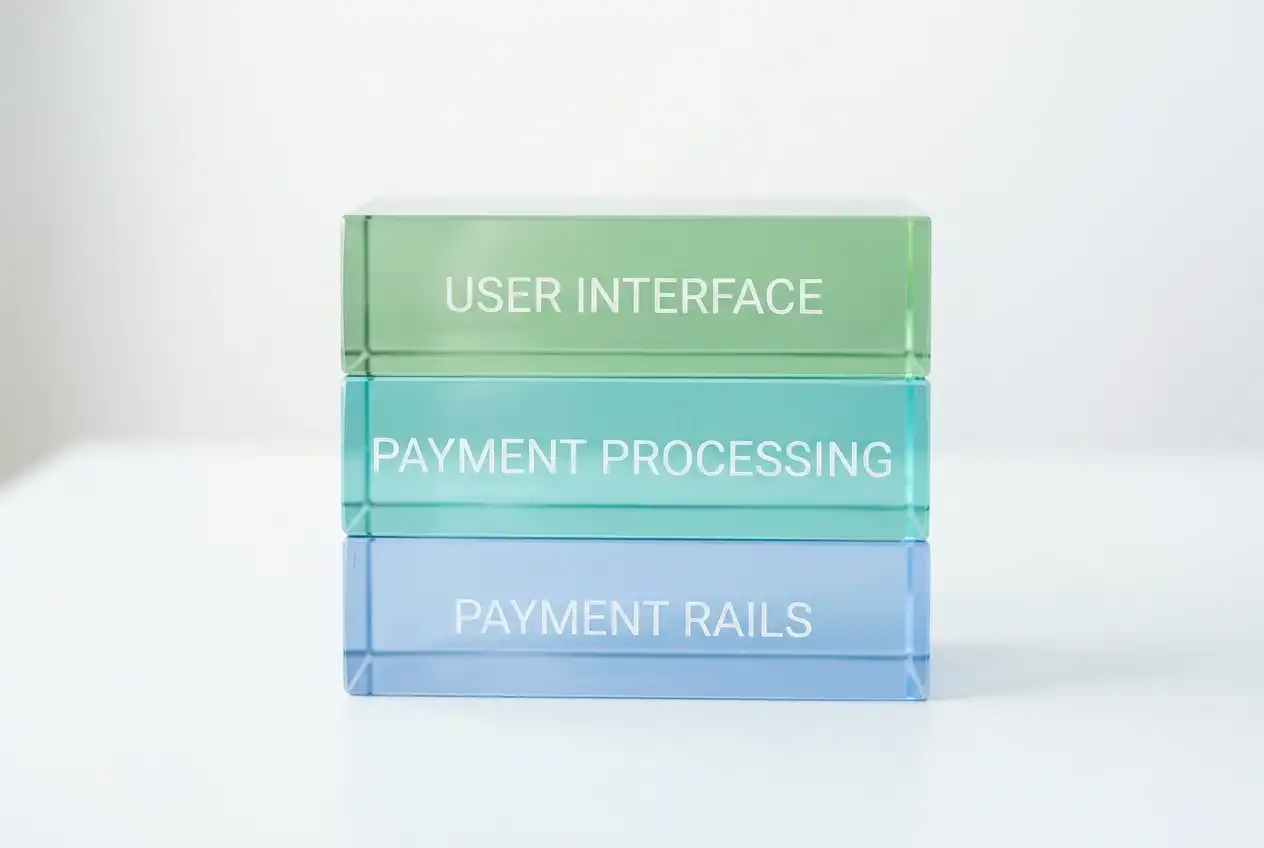
PayTo — a newer overlay service that allows third parties (including merchants and, potentially, casinos) to initiate payment requests directly from a customer's bank account, with the customer's pre-authorisation. PayTo is the NPP's answer to direct debit, but in real time.
Here is how the three layers interact in a casino context. When you make a deposit using PayID, you are initiating a push payment — you send money from your banking app to the casino's PayID. The payment travels through the NPP, settles via Osko, and arrives in the casino's account within seconds. The casino's system detects the incoming payment, matches it to your player account, and credits your balance. The entire bank-side process takes under ten seconds. The casino-side crediting is where delays sometimes creep in, and that has nothing to do with the NPP.
PayTo adds another dimension. Instead of you pushing funds, the casino could — with your pre-authorisation — pull funds from your account in real time. This is not widely deployed in the casino space yet, but the infrastructure exists and adoption is growing in other sectors. For a deeper technical breakdown of how these layers connect, I have written a separate analysis of the NPP architecture as it applies to casino transactions.
That cost efficiency — the reason most PayID casino deposits carry zero fees for the player — is what makes the entire model commercially sustainable for operators running high transaction volumes.
Best PayID Casinos in Australia — Ranked by Payout Data
Every site in this niche publishes a "top 10" list. I have read dozens of them, and the ranking criteria are almost always opaque — a mix of affiliate commission rates and subjective impressions dressed up as expert analysis. I am going to do something different here: lay out the criteria that actually matter when evaluating a PayID casino, so you can build your own ranking based on verifiable factors rather than someone else's revenue incentives.
The online casino segment in Australia reached USD 462.7 million in 2024 and is projected to grow at 14.4% annually through 2030. New operators enter constantly, and the quality gap between the best and worst is widening. A structured evaluation framework is the only way to separate platforms that have invested in payment infrastructure from those running a slow cashier page behind a PayID logo.
Payout speed
Measure the time from withdrawal request to funds arriving in your bank account. Marketing claims of "instant" should be verified against real-world testing across weekdays, weekends, and post-KYC scenarios. Anything under two hours on a verified account is strong; anything over 24 hours warrants scrutiny.
Deposit processing
PayID deposits should credit within minutes. If a platform takes longer than ten minutes to reflect a PayID deposit in your balance, the delay is on the casino side — not the banking network.
Transaction limits
Check both the casino's stated limits and your bank's PayID transfer caps. Minimum deposits typically range from AUD 10 to AUD 30. Maximum single withdrawals vary significantly — from AUD 1,600 at some platforms to AUD 10,000 or more at others.
Fee transparency
PayID deposits should carry zero fees. If a casino charges a processing fee on PayID deposits, that is a red flag — the infrastructure cost does not justify it.
KYC and verification timing
The speed of your first withdrawal depends almost entirely on how quickly the platform processes identity verification. Operators that allow you to complete KYC before your first deposit will give you faster payouts when the time comes.
Licensing and regulatory status
ACMA has blocked 1,708 illegal gambling and affiliate sites as of May 2026. Confirming that an operator is not on the ACMA blocklist — and holds a recognised licence from an established jurisdiction — is the minimum due diligence.
I deliberately avoid naming specific operators in ranked lists because affiliate economics distort rankings in ways invisible to the reader. The criteria above — payout speed, deposit processing, limits, fees, KYC timing, and licensing status — are the variables that determine your actual experience.
What to check before your first deposit
Verify the operator's licence jurisdiction. Search the ACMA blocklist. Read the withdrawal policy — specifically the sections on processing times and document requirements. Send a small test deposit and time how long it takes to credit. Complete KYC verification before you play a single hand.
What to monitor after your first withdrawal
Track the actual time between your withdrawal request and the funds arriving in your bank account. Compare weekday versus weekend performance. Note whether the platform batches withdrawals at specific times or processes them continuously. These patterns will tell you more about an operator's infrastructure quality than any review site.

For a detailed walkthrough of how to structure your first PayID casino deposit step by step, including bank-specific instructions for each of the Big Four and major neobanks, I have written a dedicated guide.
Depositing With PayID — What Actually Happens in 60 Seconds
The first time I tested a PayID deposit at an online casino, I was genuinely startled by how fast it was. I opened my banking app, entered the casino's PayID, typed in the amount, confirmed the payment, and switched back to the casino tab. The balance had already updated. The entire process — from opening the banking app to seeing credited funds — took less than fifty seconds. That experience is typical, but only when everything is set up correctly beforehand.
Here is what happens at the infrastructure level during those fifty seconds. You initiate a transfer in your banking app to the casino's PayID — usually a phone number or email address. Your bank routes the payment through the NPP, which validates the PayID, resolves it to the casino's bank account, and settles the funds. The casino's payment processor detects the incoming credit, matches it to your player account using a reference code or your registered PayID, and adds the amount to your playable balance. With 128 million accounts capable of sending and receiving via the NPP, the network handles this at scale without bottlenecks.
The matching step is where most deposit issues occur. If the reference code you include does not match your player account, or if the name on your bank account does not match your casino registration, the casino's automated system may fail to credit the deposit. In those cases, the money has already left your bank and arrived at the casino's bank — but the casino's internal system cannot assign it to you without manual intervention. This is a casino-side problem, not a PayID problem.
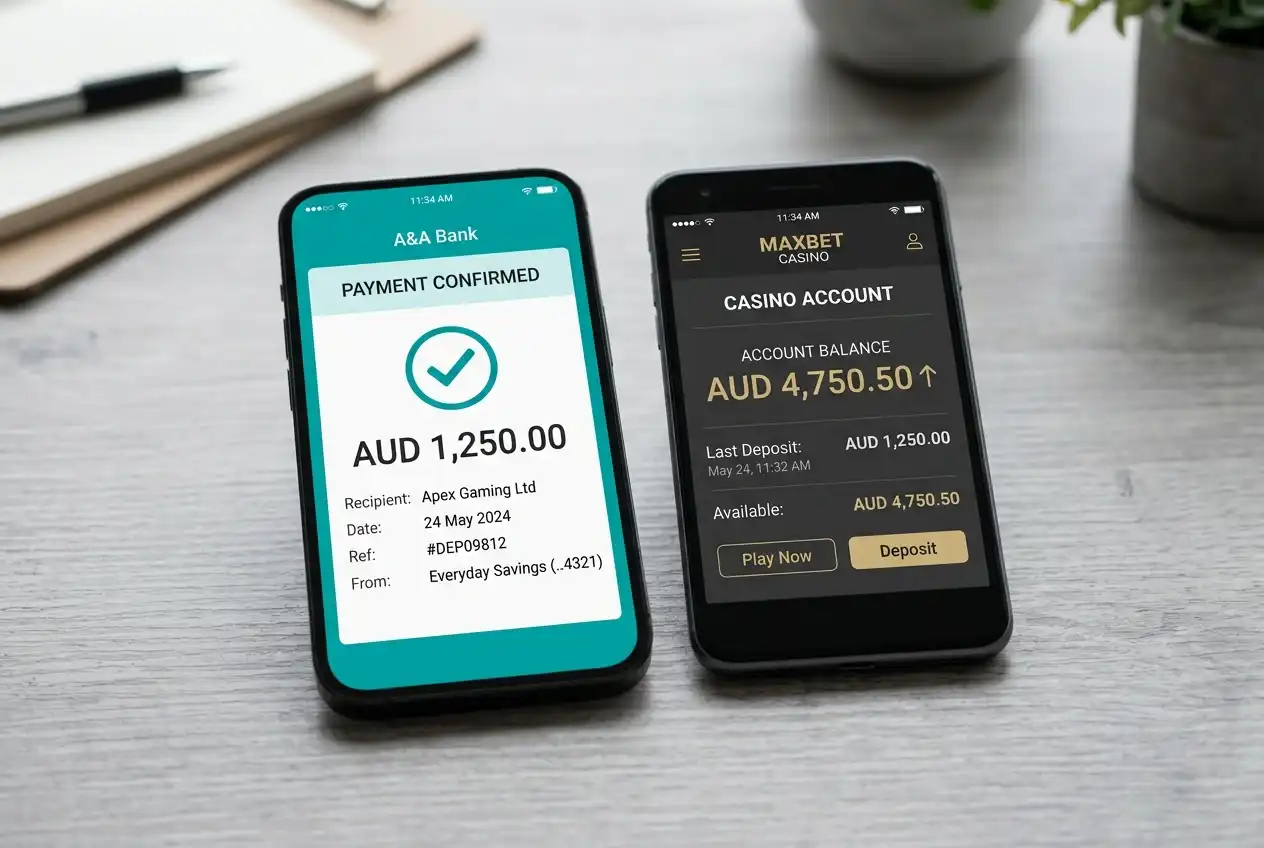
The bank side of the equation is nearly frictionless. The NPP operates around the clock, including weekends and public holidays, which means the payment infrastructure never introduces a delay. Weekly PayID usage among registered users sits at 47% — nearly half of all people who have a PayID use it at least once a week — so the system handles enormous transaction volumes without degradation.
Where deposits can stall is at the casino's end. Some platforms batch-process incoming payments rather than monitoring in real time. Others impose manual review thresholds — deposit a certain amount and a compliance officer has to approve the credit. These delays are not PayID delays. They are operational choices made by the casino.
For bank-specific deposit instructions covering CBA, Westpac, NAB, ANZ, and the major digital banks, each institution handles PayID transfers with slightly different interfaces and confirmation flows — nuances worth understanding before your first transfer.
PayID Withdrawals — Marketed Speed vs Tested Reality
If there is one area where the gap between marketing and reality is widest in the PayID casino space, it is withdrawals. I have lost count of the number of operator sites that advertise "instant withdrawals" alongside a PayID logo, as if the banking network is the only variable. It is not. The banking network is the fast part. Everything that happens before the casino sends your money to the NPP is where the clock actually runs.
A PayID withdrawal involves at least three stages: your request entering the casino's processing queue, the casino's compliance team approving the payout, and the actual fund transfer via the NPP. The NPP stage takes seconds. The other two stages can take anywhere from minutes to days, depending on the operator and your account status.
The NPP now handles more than 35% of all interbank account-to-account transactions in Australia — a figure that reflects the infrastructure's reliability and throughput. Lynn Kraus has described real-time payments as "a cornerstone of a modern and competitive Australian economy." The technology works. The question is always how quickly the casino releases the funds into that technology.
First-time withdrawals are the slowest. If you have not completed identity verification — what the industry calls KYC, or Know Your Customer — your initial payout request will trigger a document review. This means uploading a photo ID, proof of address, and sometimes a selfie for facial matching. Processing that documentation takes anywhere from one hour to 48 hours, depending on the operator's staffing and automation level. Once your identity is verified, subsequent withdrawals skip this step entirely.
Even on verified accounts, many casinos impose an internal review period. Some batch outgoing payments at set intervals rather than processing each request individually. Others have a "pending" window of 24 to 72 hours during which you can reverse a withdrawal — a responsible gambling tool that functionally delays every payout. Weekend staffing can stretch times further, even though the NPP itself runs without interruption.
The realistic expectation for a PayID withdrawal on a fully verified account at a well-run platform is between one and four hours on a weekday. Some operators consistently deliver under an hour. Others routinely take 24 hours or more. The difference is not the payment method — it is operational infrastructure. For a detailed breakdown of what "instant withdrawal" actually means after KYC and processing queues, including tested timeframes across weekday, weekend, and post-verification scenarios, I have published a separate investigation.
| Withdrawal stage | Typical duration (verified account) | Typical duration (unverified account) |
|---|---|---|
| Request enters processing queue | Immediate to 1 hour | Immediate to 1 hour |
| Internal review / compliance check | 0 to 4 hours | 1 to 48 hours (KYC required) |
| NPP settlement (PayID transfer) | Under 60 seconds | Under 60 seconds |
| Total estimated time | 1 to 5 hours | 2 hours to 3 days |

Deposit Limits, Withdrawal Caps, and Fee Structures
Three numbers define your practical experience with any PayID casino: how little you can deposit, how much you can withdraw, and what it costs. These figures vary more than most players realise, because there are two separate sets of limits operating simultaneously — the ones set by your bank and the ones set by the casino — and the lower of the two always wins.
Typical minimum deposit
AUD 10–30, depending on the operator. Some platforms accept deposits as low as AUD 5, though this is uncommon. Your bank may also have a minimum transfer amount for PayID transactions, usually AUD 1.
Typical maximum single deposit
AUD 2,000–10,000 per transaction. The Big Four banks generally set daily PayID transfer limits between AUD 1,000 and AUD 10,000 for standard accounts, with higher limits available on request.
Typical minimum withdrawal
AUD 20–50 at most platforms. Some set the floor at AUD 30.
Typical maximum single withdrawal
AUD 1,600–10,000 per transaction, with weekly and monthly aggregate caps. VIP tiers at some platforms allow significantly higher limits.
Fees
Zero in most cases. The NPP's wholesale transaction cost has dropped to approximately $0.04, making it economically viable for operators to absorb the cost entirely. If an operator charges a PayID deposit or withdrawal fee, the fee is their margin — not a network cost.
The bank-side limits are worth understanding in detail, because they create a ceiling that the casino cannot override. CBA, Westpac, NAB, and ANZ each set their own daily PayID transfer caps, and these caps vary between standard and business accounts, between new and established customers, and between mobile app and internet banking channels. Neobanks like Up, ING, and Macquarie have their own structures. I have documented the specific figures for each institution in a separate piece, because the data changes frequently and deserves its own analysis.
On the casino side, withdrawal caps are the more consequential limit. A platform might allow you to deposit AUD 5,000 in a single transaction but cap your daily withdrawal at AUD 2,000. Weekly limits of AUD 5,000 to AUD 10,000 are common at standard account tiers. Monthly aggregate caps — the total amount you can withdraw across all transactions in a calendar month — sometimes sit as low as AUD 20,000 at budget-tier operators. For large cashouts, this means your winnings may be distributed across multiple weeks, regardless of how fast the NPP can move money.
The fee landscape is simpler. The overwhelming majority of PayID casinos charge nothing for deposits or withdrawals. The NPP was designed to make real-time transactions cheap enough that fees become unnecessary at the consumer level.
PayID Security — Why Banks Prefer It Over Card Payments
Card fraud cost Australians AUD 854 million in the 2024–25 financial year — that works out to 71.8 cents for every thousand dollars spent on cards. Ten percent of the adult population, roughly 2.3 million people, reported experiencing card fraud during that period. These are not obscure statistics buried in a research paper. This is the scale of the problem that PayID's architecture was designed to avoid.
AUD 854 million lost to payment card fraud in FY25 across Australia. PayID's push-payment model eliminates the credential-sharing mechanism that enables the vast majority of card fraud.
The security advantage of PayID is structural. When you pay with a card at an online casino, you hand over your card number, expiry date, and CVV — credentials that, if leaked, allow unauthorised charges. Card payments are pull transactions: the merchant initiates the charge. PayID inverts this. You push funds from your banking app. The casino never receives your account number, BSB, or any credential that could extract money from your account.
Do
- Verify the casino's PayID (name and institution) before confirming any transfer in your banking app.
- Use a phone number or email address that you control exclusively as your registered PayID.
- Enable two-factor authentication on your banking app — this protects the only access point that matters.
- Keep your banking app updated to the latest version for security patches.
Don't
- Share your PayID with anyone who claims to need it "for verification" — no legitimate operator requires your PayID to verify your identity.
- Respond to SMS or email messages asking you to confirm a PayID payment you did not initiate.
- Use a PayID linked to a shared bank account for gambling transactions — this complicates KYC and dispute resolution.
- Ignore the recipient name confirmation that your banking app displays before you authorise a transfer.

Kai Cantwell, CEO of Responsible Wagering Australia, has described online gambling as "the safest form of gambling" because "Wagering Service Providers can identify unusual behaviour and intervene before harm occurs." That claim is specifically about the visibility that digital transactions provide. PayID reinforces this because every transaction flows through regulated banking infrastructure with built-in monitoring — banks flag unusual patterns, impose transaction limits, and can freeze outgoing payments if fraud indicators are detected. None of this is possible with cash, and it is significantly harder to implement with cryptocurrency.
The privacy model matters too. When you send a PayID payment, the recipient sees only the name associated with your PayID — not your account number, BSB, or bank. This is meaningfully better than card payments, where the merchant retains full card details, or traditional bank transfers, where the recipient sees your BSB and account number. For a deeper analysis of PayID's security architecture and how it compares to card fraud data, I have written a dedicated piece.
The Regulatory Landscape — ACMA, BetStop, and What Changed in 2024–2026
I have been tracking Australian gambling regulation for most of my career, and the period between mid-2024 and early 2026 has been the most active I have seen. Three major shifts happened in rapid succession, each one reshaping how PayID casinos operate and how players interact with them. If you are depositing real money at an online casino, understanding these changes is not optional — it is the context that determines whether your operator is playing by the rules.
The regulatory environment for online gambling in Australia changed more between June 2024 and May 2026 than it had in the previous decade. Credit card bans, a national self-exclusion register, advertising reforms, and accelerated site-blocking enforcement all landed within a twenty-month window.
The credit card ban came first. On 11 June 2024, it became illegal for Australian online gambling operators to accept deposits via credit card. The penalties are severe — up to AUD 247,500 per offence. This single regulation eliminated one of the most common (and most criticised) deposit methods overnight. The rationale was straightforward: credit cards allow people to gamble with borrowed money, which amplifies financial harm. With credit cards off the table, PayID and debit cards became the default deposit channels for Australian players.
ACMA — the Australian Communications and Media Authority — has been the enforcement arm of online gambling laws. By May 2026, ACMA had blocked 1,708 illegal gambling and affiliate websites, and more than 230 unlicensed operators had voluntarily exited the market since 2017. The blocking programme disrupts access at the ISP level. ACMA also fined Tabcorp Holdings AUD 158,000 in February 2026 for accepting prohibited in-play online bets — a signal that enforcement applies to licensed operators too, not just offshore ones.
1,708 illegal gambling sites blocked by ACMA as of May 2026. Over 230 unlicensed operators left the Australian market voluntarily since enforcement began.
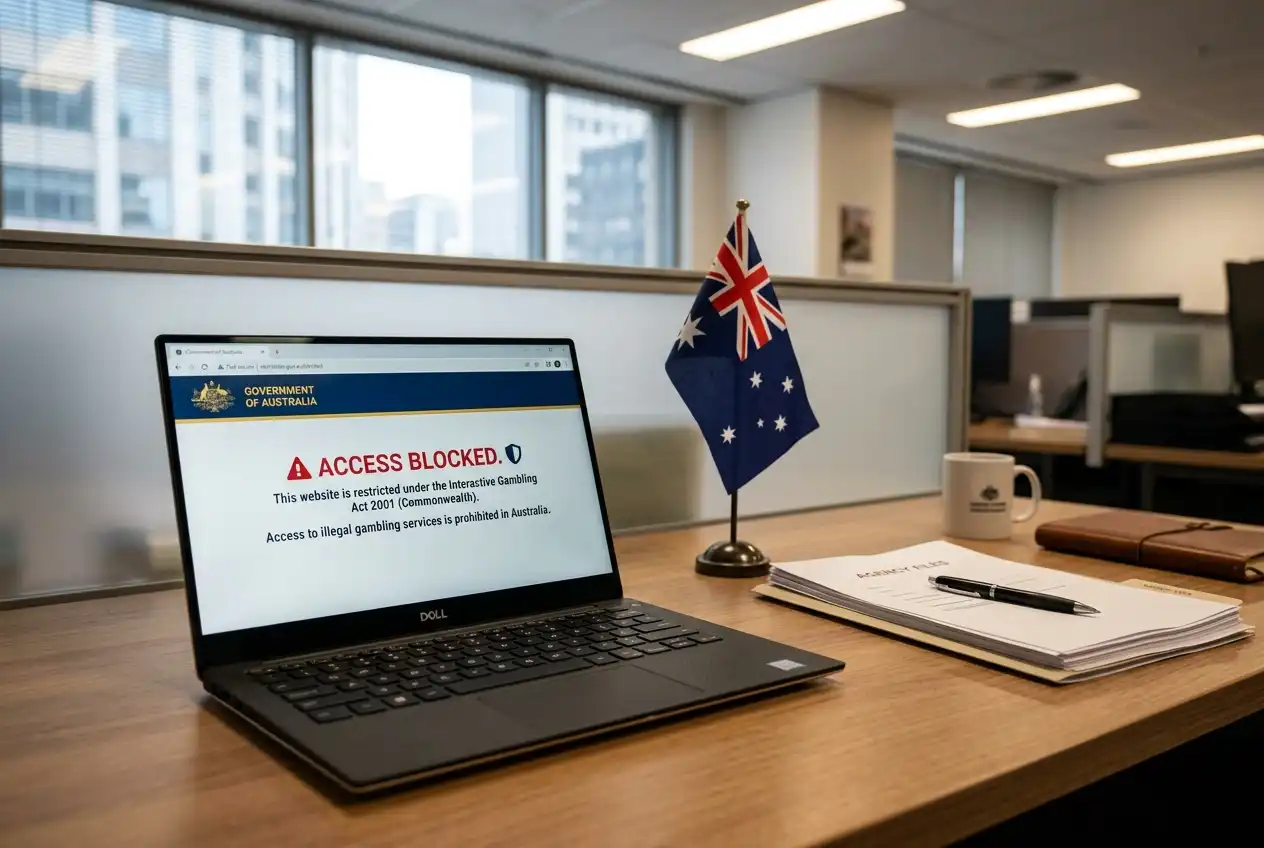
BetStop — the National Self-Exclusion Register — launched in 2023 and has been growing rapidly. By 31 March 2026, it had recorded 59,830 registrations, of which 37,247 remained active exclusions. In the first quarter of FY 2025–26 alone, 4,541 new registrations were added. BetStop allows anyone to exclude themselves from all licensed Australian wagering services for a chosen period. The register is mandatory for licensed operators: if a person is registered on BetStop, the operator must refuse their bets. Anika Wells, the Minister for Communications and Sport, framed the broader reform agenda clearly: "Our reforms will break the connection between wagering and sport, minimise children's exposure to wagering advertising, and reduce its saturation across the internet, radio and TV channels."
The next major change arrives on 1 January 2027, when new advertising restrictions take effect. The rules cap broadcast gambling ads at three per hour and prohibit gambling advertising during live sport before 20:30. Ad spend had already dropped from a peak of AUD 300 million in 2022 to roughly AUD 188 million in 2024, and the 2027 rules will compress it further. For PayID casinos, this shifts player acquisition toward organic search and content marketing.
Running parallel to these changes is an ongoing AML (Anti-Money Laundering) reform that tightens transaction reporting and monitoring for gambling operators. The direction is clear: more oversight, faster reporting, lower thresholds for triggering compliance reviews. For players, this may mean slower processing on large withdrawals as operators implement enhanced due diligence.
Australian Online Gambling Market in Numbers
The scale of online gambling in Australia is often understated in casino payment guides, but the numbers provide essential context for understanding why PayID matters as a payment rail and where the regulatory pressure is coming from.
Market size estimates vary depending on the research methodology and scope. IMARC Group valued the Australian online gambling market at USD 5.5 billion in 2025, projecting growth to USD 9.0 billion by 2034 at a compound annual rate of 5.67%. Expert Market Research offered a higher estimate — USD 6.13 billion in 2025, with a forecast of USD 13.1 billion by 2035 at a CAGR of 7.89%. The discrepancy reflects different definitions of "online gambling" (some include sports betting, others focus narrowly on casino products), but both figures point in the same direction: the market is large and growing.
Australians wagered AUD 244.3 billion in the 2022–23 financial year and lost approximately AUD 25 billion — the largest per-capita gambling losses in the world. In 2022, 72.8% of Australian adults reported gambling within the previous twelve months.
The shift toward digital is accelerating. In 2025, 56.1% of active gamblers indicated that they played predominantly online — a majority that would have been unthinkable a decade ago, when land-based venues and TABs dominated. This migration to online platforms is precisely what created the demand for faster, cheaper, more convenient deposit methods. PayID did not create the online gambling market in Australia. The market created the demand, and PayID filled it.
The social cost is substantial and increasingly visible in public policy. The federal government estimates annual gambling harm at AUD 4.7 billion nationally. The Victorian government's own analysis puts the figure at AUD 14.1 billion for that single state alone — a number that reflects healthcare costs, productivity losses, family breakdown, and criminal justice expenses attributable to problem gambling. These figures underpin every regulatory intervention discussed in this guide, from the credit card ban to BetStop to advertising restrictions.
PayID vs Other Payment Methods — a Head-to-Head Breakdown
When I started covering casino payment methods in 2017, the landscape was dominated by credit cards, e-wallets, and traditional bank transfers. Today, the choice set in Australia looks completely different. Credit cards are banned for gambling. POLi is fading. Crypto has carved out a niche but remains volatile and unregulated. PayID sits at the centre, but it is not the only option — and understanding where each method excels (and fails) helps you make better decisions about how to move your money.
The comparison below focuses on characteristics, not brands. Every player's priorities differ — some value speed above all else, others prioritise privacy, and a significant segment cares most about withdrawal limits. The data is drawn from publicly available infrastructure specifications and general industry practice.
| Characteristic | PayID / NPP | Traditional bank transfer (BECS) | Debit card | Cryptocurrency |
|---|---|---|---|---|
| Deposit speed | Under 60 seconds | 1–3 business days | Instant to minutes | Minutes to 1 hour (varies by chain) |
| Withdrawal speed (bank side) | Under 60 seconds | 1–3 business days | 1–5 business days | Minutes to 1 hour |
| Deposit fee (typical) | Zero | Zero | Zero to 2.5% | Network fee (variable) |
| Withdrawal fee (typical) | Zero | Zero | Often unavailable | Network fee (variable) |
| Credential sharing | None (push payment) | BSB + account number | Full card details | Wallet address only |
| Regulatory status in AU | Fully regulated (NPP / RBA) | Fully regulated | Fully regulated (credit banned) | Largely unregulated for gambling |
| Availability (24/7) | Yes | Business days only | Yes | Yes |
| Currency risk | None (AUD to AUD) | None | None (domestic) | Significant (token volatility) |
Less than 13% of retail transactions in Australia are now paid in cash, and 44% of in-person transactions use mobile wallets like Apple Pay, Google Pay, or Samsung Pay. The broader trend is unmistakable: Australians are migrating to digital-first payment methods, and PayID is the most frictionless digital option for moving money between a bank account and a casino account.
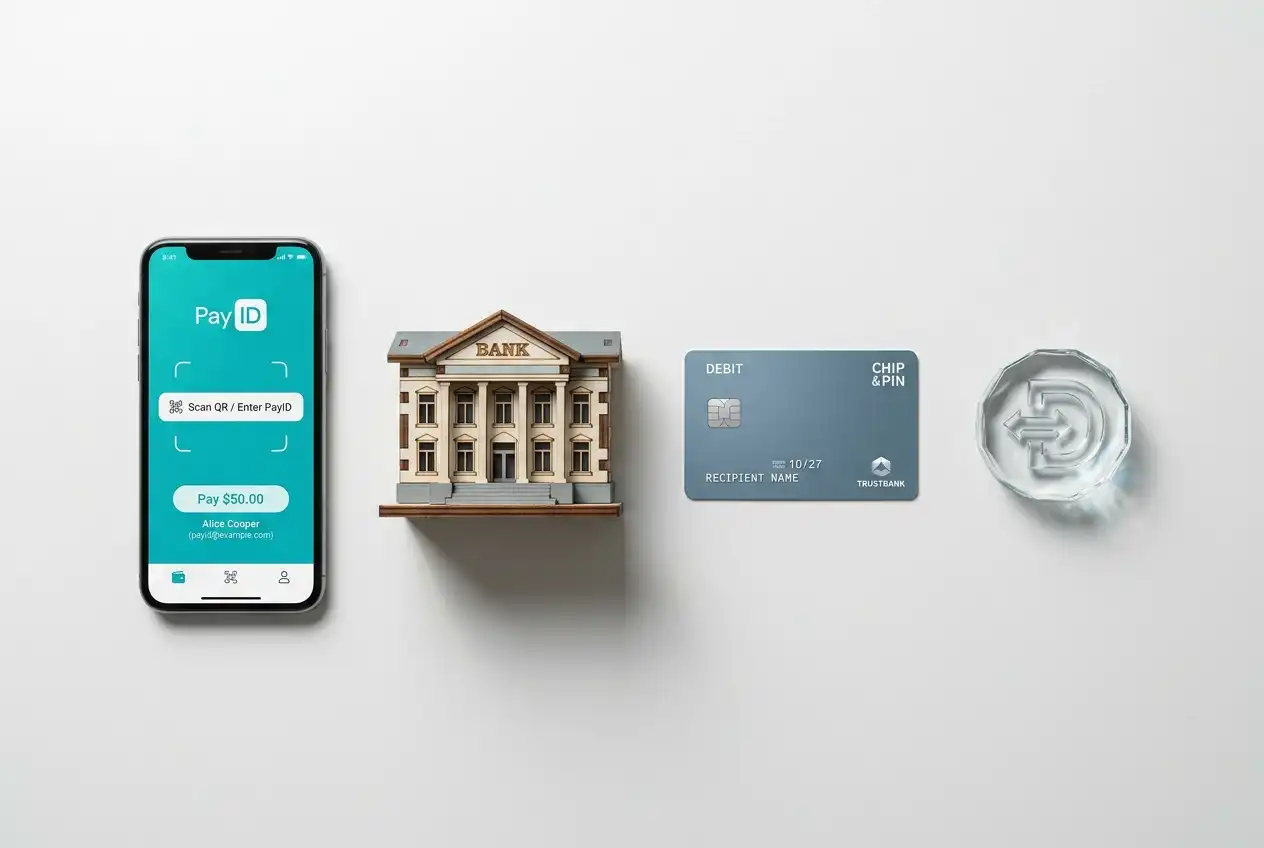
Traditional bank transfers still work but belong to a batch-processing era that feels increasingly outdated when the NPP can settle the same transaction in seconds.
Cryptocurrency deserves a nuanced assessment. It offers speed comparable to PayID and stronger privacy (wallet addresses are pseudonymous). But it introduces currency risk — the AUD value of your deposit can shift between the time you buy the token and deposit it. It also operates outside Australia's regulated banking framework, meaning dispute resolution and fraud recovery are effectively nonexistent. For a detailed comparison of PayID versus traditional bank transfers, including fee structures and infrastructure differences, I have published a dedicated analysis.
PayID Casino Bonuses and Deposit Offers Worth Checking
Bonuses are the loudest part of the online casino experience — every operator leads with a number, a percentage, a free spin count. After nine years of dissecting bonus terms, I can tell you that the headline figure is almost never the number that matters. What matters is the wagering requirement, the game contribution weighting, the maximum bet while playing through bonus funds, and the withdrawal cap on bonus winnings. PayID deposits interact with all of these mechanics, and in some cases the deposit method itself affects eligibility.
The most common bonus structures at PayID casinos fall into three categories: deposit match bonuses, free spin packages, and cashback offers. Each has different implications for when and how you can withdraw winnings, and the deposit method itself sometimes affects eligibility.
Deposit match mechanics
Wagering requirements on deposit matches typically range from 25x to 45x the bonus amount (sometimes the bonus plus deposit combined). At 35x on a AUD 200 bonus, you need to wager AUD 7,000 before the bonus funds convert to withdrawable cash. Slot games usually contribute 100% toward the wagering requirement; table games contribute between 5% and 20%. Some operators exclude certain game categories entirely.
Free spin terms
Free spins are tied to specific titles, and the winnings are almost always credited as bonus funds with their own wagering requirements. A package of 50 free spins might generate AUD 15 in winnings, which then requires 30x wagering (AUD 450 in bets) before you can withdraw. Maximum withdrawal caps on free spin winnings are common — often capped at AUD 100 to AUD 500 regardless of how much you wager through.
Cashback structures
Cashback is generally the most player-friendly bonus type because it is often credited as real cash (no wagering requirement) and calculated on net losses rather than deposit amounts. Daily cashback of 5–15% on net losses is a common structure. The absence of wagering requirements makes cashback offers significantly more straightforward to evaluate than deposit matches or free spins.

PayID deposits are accepted for bonus activation at virtually all operators that support the method. Unlike some e-wallets or crypto deposits — which are occasionally excluded from promotions — PayID carries no method-based restrictions at the platforms I have reviewed. Minimum deposit thresholds for activation vary from AUD 10 to AUD 100 depending on the offer tier.
The single most useful habit I can recommend is reading the full bonus terms before depositing. Pay particular attention to the wagering multiplier, game contribution percentages, maximum bet per spin while wagering through bonus funds, and time limit for completing the requirement. These four variables determine whether a bonus is genuinely valuable or a mechanism that makes withdrawing harder.
Responsible Gambling Tools for PayID Casino Players
Writing about payment infrastructure without addressing gambling harm would be irresponsible, and I am not going to do it. The same speed that makes PayID attractive for deposits — instant, frictionless, available 24/7 — also removes the natural friction that once gave people a pause before transferring more money. When a deposit takes three days to process, there is time to reconsider. When it takes three seconds, there is not.
BetStop, the National Self-Exclusion Register, is the most significant structural intervention available to Australian players. Tens of thousands of people are actively using it — the register is not theoretical. Registering blocks you from all licensed Australian wagering services for a period you choose, and licensed operators are legally required to enforce the exclusion. The register operates at the operator level, not the payment level, which means it blocks account access rather than blocking PayID transfers specifically.
Anika Wells, Australia's Minister for Communications and Sport, has called gambling addiction "a serious public health issue" and described the current reform programme as the strongest in the country's history. The tools below exist because the harm is measured in billions — not millions — and the government has decided that voluntary self-regulation is no longer sufficient.

Beyond BetStop, most PayID casinos offer a suite of self-management tools: deposit limits (daily, weekly, monthly), session time reminders, cooling-off periods that temporarily suspend account access, and activity statements that summarise your transaction history. These tools are worth using regardless of whether you consider yourself at risk. Setting a weekly deposit limit in advance — when you are thinking clearly about your budget — is a fundamentally different decision from deciding how much to deposit in the moment, after a losing streak, at two in the morning.
If you or someone you know is experiencing gambling-related harm, the National Gambling Helpline provides free, confidential support. Understanding payout rates and bankroll management is also part of informed play — knowing how the mathematics of slot machines and table games work helps calibrate expectations before money is on the line.
Frequently Asked Questions
What is a PayID casino and how does it work?
A PayID casino is an online gambling platform that accepts deposits and processes withdrawals through Australia's PayID system — an addressing layer on the New Payments Platform. Instead of entering a BSB and account number, you link a phone number or email to your bank account and use that identifier to transfer funds. Deposits settle in seconds via the NPP. Withdrawals work in reverse: the casino sends funds to your registered PayID, and the money arrives once the casino releases the payment.
Is PayID safe for online casino deposits and withdrawals?
PayID is structurally safer than card-based payments because it is a push-payment system. You send money from your banking app — the casino never receives your account number, BSB, or any credential that could be used to extract funds. Card payments require sharing credentials that a data breach could expose. PayID transactions flow through the NPP, supervised by the Reserve Bank of Australia, and processed through your bank's security framework including two-factor authentication and transaction monitoring.
How fast are PayID casino withdrawals?
The banking side takes less than 60 seconds. Total time depends on the casino's processing speed. On a verified account, expect one to four hours on weekdays. First-time withdrawals take longer because KYC verification must be completed — adding one hour to 48 hours depending on the operator. Some casinos impose a pending period of 24 to 72 hours. Weekend processing may be slower due to reduced staffing, even though the NPP operates continuously.
What are the deposit and withdrawal limits for PayID casinos?
Limits operate at two levels: your bank's PayID transfer caps and the casino's transaction limits. Minimum deposits range from AUD 10 to AUD 30. Maximum deposits are constrained by bank-side daily PayID limits — AUD 1,000 to AUD 10,000 at the Big Four depending on account type. Casino withdrawal caps are usually the binding constraint: daily caps of AUD 2,000 to AUD 5,000 and weekly caps of AUD 5,000 to AUD 10,000 are common. VIP programmes may offer elevated limits.
Which Australian banks support PayID for casino payments?
All four major banks — Commonwealth Bank, Westpac, NAB, and ANZ — support PayID and are connected to the NPP. Digital banks including ING, Macquarie, Up, and Bendigo Bank also support it. With 128 million accounts enabled on the NPP, the vast majority of Australian bank accounts can send and receive PayID payments. The real question is whether your bank restricts transfers to gambling-related accounts — some institutions apply gambling-specific blocks that require you to adjust settings before transfers are permitted.
Are there any fees for using PayID at online casinos?
In the vast majority of cases, no. PayID deposits and withdrawals carry zero fees at most online casinos. The NPP's wholesale transaction cost has dropped to approximately AUD 0.04 per transaction, which makes it economically viable for operators to absorb the cost entirely. Your bank does not charge a fee for sending a standard PayID transfer. If a casino does charge a fee on PayID transactions, that fee represents the operator's margin rather than a network or banking cost.
What is the difference between PayID and PayTo for casino payments?
Both run on the NPP but work in opposite directions. PayID is a push-payment system — you initiate the transfer and send funds to the recipient. PayTo is a pull-payment system — the recipient sends a payment request to your bank account, which you authorise. PayTo is not yet widely adopted in the casino space, though the infrastructure is live. The key difference is control: with PayID, you initiate every transaction; with PayTo, you pre-authorise the casino to request funds.
Pokies
Casino Dice Game Australia: Rules and Game Types
Compare dice formats, betting rules, live tables and digital games, including Craps, Sic Bo and crash-style products. What Counts as a Casino Dice Game in Australia? A casino dice game…
Best High-Cashback Online Casinos in Australia
Understand cashback terms, bonus restrictions and the legal position of offshore casino…
Best Casino Payment Methods for Aussies
See how Australian casino deposits, withdrawals, payment providers and checkout checks fit…
Best Pokies in Canberra: Venues and Online Rules
Understand local machines, venue options, online legality, opening hours, RTP, and the…
Created by the "PayEdge" editorial team.