
PayID Casino Tax — What Australian Players Need to Know
 Available in AU
The Tax Question That Kept Me Up at Night
After a particularly good run at live blackjack a few years ago, I sat staring at my bank statement wondering whether the ATO was about to take a significant cut. The withdrawal had landed in my account via PayID within hours, and the amount was large enough to make me nervous. I spent the next two days reading tax rulings, forum threads, and accountant blogs before arriving at an answer that surprised me — and that I suspect surprises most Australian players when they first encounter it.
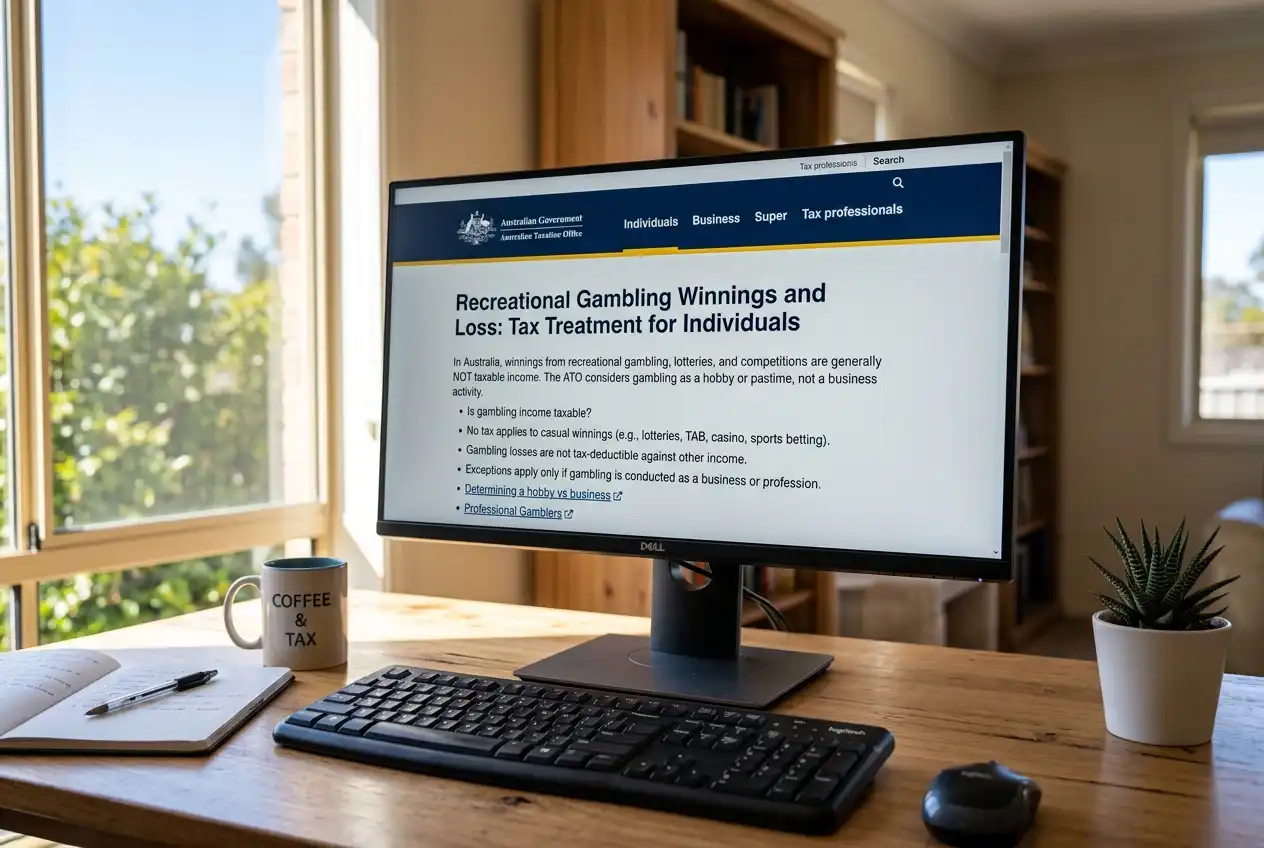
The short version: recreational gambling winnings are not taxed in Australia. But that sentence carries more nuance than it appears, and the conditions that separate “recreational” from “professional” gambling are neither as clear nor as forgiving as most players assume. The payment method — PayID, card, bank transfer — does not change your tax obligations. What changes them is how the ATO characterises your gambling activity, and that characterisation depends on factors most players have never considered. The wider context is covered in our PayID casino guide.
Why Recreational Gambling Winnings Are Tax-Free
Australia’s tax treatment of gambling is unusual by global standards. Under the Income Tax Assessment Act 1997, gambling winnings are generally not assessable income because they are considered a windfall rather than the product of an income-earning activity. The ATO’s position, established through decades of case law and rulings, is that a casual punter who wins money through luck or entertainment-based play is not conducting a business and therefore is not earning taxable income.

This principle applies regardless of the amount. A AUD 500 win from pokies and a AUD 50,000 win from a progressive jackpot receive the same treatment — neither is taxable if the player is a recreational gambler. The corollary is equally important: recreational gambling losses are not tax-deductible. You cannot offset a losing year against other income, claim a deduction for deposits, or treat gambling expenditure as a business expense. The tax-free status of winnings comes paired with the non-deductibility of losses, and you cannot have one without the other.
Australians wagered AUD 244.3 billion in the 2022-23 financial year, the vast majority of it by recreational players. The tax-free treatment of those winnings is a deliberate policy choice — taxing recreational winnings would require a reporting framework that neither the ATO nor the gambling industry is equipped to administer at that scale.
When Gambling Becomes a Business — The Professional Player Threshold
Here is where it gets complicated. If the ATO determines that your gambling constitutes carrying on a business, your winnings become assessable income, subject to marginal tax rates like any other business revenue. The distinction between recreational and professional gambling is not defined by a bright line — it is assessed based on a collection of factors that the ATO evaluates holistically.

The factors that push toward a “business” classification include: systematic and organised approach to gambling (using documented strategies, tracking tools, or analytical software), regularity and volume of play that resembles a commercial operation, the expectation of profit as a primary motivation rather than entertainment, and the scale of turnover relative to the player’s other income. A poker player who grinds eight hours a day, maintains detailed session logs, and derives the majority of their income from winnings is far more likely to be classified as a professional than a weekend pokies player.
The leading case is Evans v. Federal Commissioner of Taxation (1989), which established that a systematic horse bettor was carrying on a business of gambling. The court considered the taxpayer’s methods, record-keeping, regularity of betting, and the commercial nature of the operation. Subsequent cases have refined but not replaced this framework. If you can look at your gambling activity and honestly say it resembles a hobby more than a job, you are almost certainly on the recreational side of the line.
PayID, Transaction Trails, and ATO Visibility
Does using PayID make your gambling activity more visible to the ATO? In a practical sense, yes — though not in the way most players fear. PayID transactions flow through Australia’s New Payments Platform and are recorded in your standard banking history. The ATO has data-matching programs that access financial institution records, and large or frequent transfers to known gambling operators can flag an account for review.

This is not unique to PayID. Any bank-linked payment method — debit card, direct transfer, BPAY — creates the same paper trail. What PayID adds is clarity: the transaction descriptions in your bank statement often include the operator’s name and the PayID identifier, making gambling-related transactions easier to identify than a generic card charge labelled with a merchant code. For recreational players, this transparency is irrelevant because the winnings are not taxable. For players operating near the professional threshold, the audit trail is worth considering.
The NPP’s wholesale cost has dropped to approximately $0.04 per transaction in the 2025 financial year, which means neither the bank nor the infrastructure provider has a financial incentive to limit transaction reporting. Every PayID transfer is logged, timestamped, and attributed to a verified identity. That data exists whether or not the ATO ever looks at it.
Record-Keeping Even When You Do Not Owe Tax
I keep records of every gambling deposit and withdrawal, and I recommend the same to anyone who plays regularly. Not because I expect a tax bill, but because the absence of records is the worst possible position to be in if the ATO ever does ask questions. A clean transaction log showing deposits, withdrawals, net position, and the recreational nature of your play is the fastest way to resolve any inquiry.

Your banking app already tracks PayID transactions with dates, amounts, and recipient details. Supplementing that with a simple spreadsheet — date, operator, deposit amount, withdrawal amount, net result — takes five minutes per session and creates a complete picture of your gambling activity over time. If you ever need to demonstrate that your play is recreational rather than professional, that record is your strongest evidence.
For players who also gamble in other jurisdictions, the cross-border payment landscape adds a layer of complexity. Winnings from overseas operators may be subject to the tax laws of the jurisdiction where the operator is licensed, and double-tax agreements between Australia and other countries may apply. The tax-free treatment of recreational winnings is an Australian domestic provision — it does not automatically extend to every international gambling transaction.
What Happens With Large Withdrawals
A single large PayID withdrawal from a casino — AUD 10,000 or more — can trigger an AUSTRAC (Australian Transaction Reports and Analysis Centre) reporting obligation on the operator’s side. This is not a tax event. AUSTRAC reporting exists for anti-money-laundering and counter-terrorism-financing purposes, not for income tax assessment. The operator reports the transaction to AUSTRAC, which maintains it in their database. The ATO may access AUSTRAC data as part of their data-matching programs, but a reported transaction does not imply a tax obligation. Your bank statements are the record: transaction history.
For recreational players, large withdrawals are simply winnings returning to their bank. No tax is payable, no return needs to be lodged specifically for the withdrawal, and no additional reporting obligation falls on the player. The anxiety that large payouts trigger is understandable but, for genuine recreational players, unfounded. Keep your records, understand the distinction between recreational and professional play, and let the tax position take care of itself.
Published by the PayEdge team.